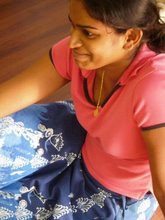
Hi, I have two great news.
No. 1,
One of my teachers, Doug Crouch from the US is coming down to teach the Permaculture Design Certificate Course in Malaysia. He is coming with one of his colleagues, Kaila Binney who will also be teaching the course.
No. 2,
The 2 week Permaculture Design Certificate Course will be held at Embun Pagi, a permaculture demonstration site that I have been working on for the past 6 weeks.
Download the Permaculture Design Certificate brochure here
and Please visit http://embunpagi2009.wordpress.com/ for more details
Wednesday, February 25, 2009


I thought I knew you before I met you …
I thought I knew you before I met you …
America
Though we are far apart, I had you for breakfast, lunch and dinner.
I thought I knew you before I met you …
Parts of you, America dripped nectar on my taste buds,
Tempting me with yearning for all things sweet.
Parts of you, America stung with the bitterness of bile,
Oozing trepidation for life, not mine, shoved into my throat.
Parts of you, America filled my bosom with the bread of contentment,
Baked from the yeast of indifference.
And parts of you America drained my heart with bottomless hunger,
Slithering in the stomachs of my ancestors.
Yet, America
There was much more to you than three meals a day,
For you are greater than the sum of your parts.
ii.
And now, alas, I am here in America …
I am thankful for having the privilege of getting to know you, America
As I lie on this meadow which carried the feet of Native Indians,
And listen to your heart drumming on the ground beneath my ear,
I recall each beat, each flutter of smile, each encounter of eyes,
Each person bearing beautiful gifts of exchange,
-: The genuine listening, the sincere conversations,
Good intentions, respect for one another,
The pouring out of the heart, the reaching out of a hand.
The strangers...
Who always had a smile or a nod to spare.
The people on the sidewalk...
Who were more than generous with their directions.
The bus driver who went out of his route so I would not get lost.
The receptionist at the museum who gave me a free pass.
The priest who told the story behind each passing town as we journeyed by train.
The boy on the plane who gave me his jacket, so I could stay warm.
The lady on the bus who gave me a hug, and a magic spell.
So many encounters more!
Sun beams waving smiles in the melancholy of fall.
America, you are truly the land of dreams,
As you are too the conjurer of nightmares .
iii.
I am grateful for the ticking and placing of time, which brought me across the sea of indifference, and fear, and placed me at the feet of the throne of dreams - There to witness the opportune moment of the mother, Dream Weaver giving birth to her son.
Dream Catcher!
People of many colors, speaking one language, dreaming the same dream in their midnight slumber. The hand of the moon walked upon the face of the earth, returning full circle at the 11 th hour to greet the new son born to a new dawn. Fireworks, jubilation, a sigh of relief. Triumphant fists dancing in the air, moving to the sound of hope.
Yes we can! Yes we can!
Yes we can! Yes we can! Malaysia Boleh!
I think of my homeland, and loved ones …
Perhaps, we can dream too.
I am grateful …
For being in a moment engraved on the leaf of history, a mouth among millions, reaching for the skies, drinking in the promise of a better tomorrow.
And as for you America,
Had I known I loved you before I met you, I would have loved myself a little bit more.
God bless the United States of America, and God bless us all.
Special thanks to the US Embassy and IVLP team: Gloria, Marta, Diane, Anni Bel, Elaine
Monday, February 23, 2009
Back From USA
 Class of 2008 Fall PDC, Lost Valley, USA
Hello everyone!
Salaam to my wonderful sponsors and friends who have given me their blessings and support. I hope these times find you well. It is good to be back.
I had a glorious time in the US. Celebrated the triumph of Barack Obama on election night, met a lot of amazing people, saw wonderful places & lovely endeavors…felt very at home. It was hard to say goodbye... so I tried postponing it as long as possible. I extended my stay in the US for three weeks to do a short permaculture internship at Lost Valley. I had initially planned to extend it for a whole 2 months and do a longer internship, but a friendly trip to the visa enforcement agency set me back on a short but safe track home.
I got back on Nov 15, eager to start my Permaculture project… but it took me quite a while (2 months to be exact) to get my act together. Though my roots were not too deeply settled in KL, shifting back to my hometown in Batu Arang was not an easy move. A small town, at the end of a windy road… How was I going to make ends meet and do the things I wanted to do? Where was I going to start planting? … And mind you … I’m not only interested in planting trees and vegetables, I want to plant Permaculture seeds.
With the Mayan Calendar coming to an end in 2012, the climate going bezerk, and the economic collapse, a red light blinks incessantly over our heads screaming for attention. I wake up each morning with a slap of reality check on my face. We're seconds away from a global transformation that will most definately involve a lot of destruction as well as construction. Each and every one of us will not be able to escape from contributing to this transformation. Who is going to destroy? Who is going to build? What will be destroyed? What will be saved? I do not have the answers, but I do not feel helpless. Permaculture has given me a choice, a choice to create and not to destroy, and it has given me the tools to do so. I do not have control over what happens in the future ... but I can pass down my legacy, along with many others ... and hopefully, this legacy will be the ground on which our children walk on.
.
Now, we have to move fast, while there is light! I'll be back with some progress soon.
.
.
.
Peace and Love,
Sabina Arokiam
Sunday, August 10, 2008
What Is Permaculture?
Permaculture which was first developed as Permanent Agriculture, and then later on evolved into Permanent Culture is about creating sustainable human habitats by following nature's patterns." It uses the diversity, stability and resilience of natural ecosystems to provide a framework and guidance for people to develop their own sustainable solutions to the problems facing their world, on a local, national or global scale. It is based on the philosophy of co-operation with nature and caring for the earth and its people.
Permaculture DEFINITION
Permaculture DEFINITION
- A globally recognized environmental design methodology. The founders of Permaculture, Bill Mollison and David Holmgren, coined the term 25 years ago. Now there are over 4000 independently operated projects in 120 countries
- A holistic ecological approach to the design and development of human settlements takes into account food production, structures, technologies, energy, natural resources, landscape, animal systems, plant systems, and social and economic structures.
- About working with, rather than against, nature. It provides us with the tools to satisfy our needs in a way that sustains the earth, future generations and ourselves.
- Inspired by traditional wisdom, especially the sustainable farming cultures of Asia, India and Africa and incorporates new appropriate methods and technologies.
Permaculture ETHICS & PRINCIPLES
EarthCare Permaculture as a design system is based on natural systems. It is about working with nature, not against it - not using natural resources unnecessarily or at a rate at which they cannot be replaced. It also means using outputs from one system as inputs for another (vegetable peelings as compost, for example), and so minimizing wastage.
PeopleCare People care is about looking after us as people, not just the world we live in. It works on both an individual and a community level. Self-reliance, co-operation and support of each other should be encouraged. It is, however, important to look after ourselves on an individual level too. Our skills are of no use to anyone if we are too tired to do anything useful! People care is also about our legacy to future generations.
FairShare The fair shares part of the Permaculture ethic brings earth care and people care together. We only have one earth, and we have to share it - with each other, with other living things, and with future generations. This means limiting our consumption, especially of natural resources, and working for everyone to have access to the fundamental needs of life - clean water, clean air, food, shelter, meaningful employment, and social contact.
This article has been extracted from resources made available on the Permaculture Association of Britain website
Request for Support to Attend a Permaculture and Ecovillage Design Course
For the past 1 year, I have been nurturing the intention to attend a Permaculture and Ecovillage Design Course, being offered from time to time, in a few countries outside Malaysia. Lack of funds for flight ticket, tuition fees, accommodation and lodging have impelled me to put aside this aspiration until a suitable opportunity presented itself, and I think that opportunity has arrived!
I have been sponsored by the US embassy to participate in a 3 week exposure program on NGO Management (see previous post for details) from the 31 August 2008 - 19 September 2008. Coincidentally, a one month Course on Permaculture and Ecovillage Design will be taking place in Oregon a week after my exposure ends. The course is being offered at the Ecovillage and Permaculture Institute of Lost Valley, from 29 September – 24 October 2008.
Finally, the stars in heaven have aligned after a whole year of brewing intentions. I wrote in to register for the Permaculture and Ecovillage Design course, and my application was accepted! As my flight is already being taken care off by the US Embassy, I will only have to worry about finding USD 2000 which covers my course fee, food and accommodation for the entire month. I would like to take this opportunity to request for sponsorship amounting to USD 2000 to support my intentions.
My commitment
1. I will document my entire trip, and offer to share my experience, and knowledge gained from the Permaculture and Ecovillage Design course to individuals/groups/organizations who are interested. My sharing will be made available through presentations, workshops and hopefully published documentation.
2. I also intend to start a pilot Permaculture project for marginalized communities, in a village in Batu Arang which is about 40km’s away from Kuala Lumpur. I am already in discussion to work on a project with my father, Alex Arokiam, an Exco member of the Malaysian Aids Council, who runs several community homes and agriculture initiatives with persons living with HIV/AIDS (PLWHA’s) and refugees from Myanmar.
PLWHA’s have difficulty securing and maintaining jobs due to their health condition and stigma associated with the disease, and refugees are not allowed to work in Malaysia. Permanent Agriculture or Permaculture (abbreviated) is one of the viable practices that can be incorporated into these communities with limited resource and access to economic sustenance.
The earth is non discriminative and non-judgmental. It is also a highly therapeutic medium. Working with the surrounding land in a sustainable and enriching way, through constructive and positive activities will lead to a restored sense of dignity and provide job satisfaction to these marginalized communities.
The following are possible sites that have been identified for the pilot Permaculture project:


Site 1: 2.5 acres of land with jasmine plantation, next to an old mining pool


Site 2: 2.0 acres of land surrounding Welcome Community Home for men living with HIV/AIDS


Site 3: 1.5 acres of abandoned land


Site 4: 2 acres of farmland surrounding the Positive Living Community Home
Wednesday, August 6, 2008
The US Embassy International Visitor Leadership Program
I was recently invited by the US Embassy to participate in a three week exposure under the International Visitor Leadership Program (IVLP) on NGO Management. The IVLP which is sponsored by the U.S Department of State has distinguished alumni which include such individuals as Margaret Thatcher, Anwar Sadat, Giscard D'Estaing, Indira Gandhi, Julius Nyerere, F.W. deKlerk, Tony Blair and our very own Anwar Ibrahim. I feel very honoured to be given the privelage to participate in such a program.
My program focus is on NGO Management. Key areas of interest that have been suggested for our program line up include Permaculture, Environmental Awareness, Media Literacy, Participative Arts, Alternative-Informal Education/Learning, Youth Development and Support, Community Development, and Fundraising and networking.
I will leave for the US on the 30th of August. The program will end on the 19th of September. It is less than a month away!
Is this for real? I still can't believe that I am actually going to the US, and I can't think of a better time to go... with the seeds of change wafting in the air. I hope I bump into Obama ...
Stories From the Heart, by Refugee Kids for Refugee Kids
Creative Facilitator
Storytelling Workshop for Refugees
2008
Recently, Chris Ng and I were awarded a RM 10,000 grant to run a 3 month story telling workshop for Myanmarese refugee kids. The two newspaper articles gives a brief description of the grant and its grantees.
http://www.nst.com.my/Current_News/NST/Thursday/Features/20080730150227/Article/indexF_html
http://www.nst.com.my/Current_News/Streets/Monday/Stories/2285768/Article/
Chris and I are conducting separate workshop sessions for a total of 30 Myanmarese refugee kids, from two ethnic communities. Each workshop comprises 12 x 3 hour sessions.
This is an excerpt from our proposal:
There are 10,000 registered refugee children in Malaysia. Many more may be unregistered… how many exactly, no one knows for sure. They live in an environment where normal childhood development is a constant challenge. Their priorities are survival and escaping the authorities. Formal education, for most of them is a fairy tale, something to dream about, never to achieve.
While the registered children have a glimmer of hope of going to a foreign adopted land, the reality is many of them will spend at least a few years of ‘lost childhood’ growing up in the jungles, squatters or crowded flats that they call home, here in Malaysia. These children have stories to tell. These stories need to be told so that they know they are not alone…displaced…in a community where they struggle daily to make their presence invisible. They need a voice, one that is seldom heard, if at all. They need to share their stories of laughter, of dreams, of hope, of life because they are living it. They need to tell these stories because the stories come from their hearts. They own these stories.
Environmental Art
Art Installation
Zero Energy Markers
‘Zero Energy Homes’ Launch
Nov 2007, Bird Island, Sentul Park 


It's a relief to know that some of the housing developers in Malaysia have started looking into greener technologies for buildings. With energy and environmental issues being in the forefront of their CSR (Corporate Social Responsability) initiatives , YTL Land and Development Berhad initiated the Bird Island Green Zero Energy Homes Competition, the first green (or sustainable) architectural competition of its kind, in recognition of the fact that energy-efficient buildings are the future of architecture and building design.
Eight architects and designers from six countries - UK, Germany, Australia, Hong Kong, China, and USA were chosen by YTL to submit designs for six Eco-friendly homes on Bird Island.
The tiny island is a green haven located in the 35-acre Sentul Park, part of YTL Land's iconic urban renewal development in Sentul, within a social and cultural landscape that is supportive of contemporary design and architecture.
I was one of the 7 artists invited to erect art installations to commemorate the launching of the project. As Sentul Park was once a railway hub, I decided to mount discarded railway slippers along the Sentul Park landscape to symbolize ‘100 – 0 energy’ countdown markers for the ‘Zero Energy Homes’ project.
Zero Energy Markers
‘Zero Energy Homes’ Launch
Nov 2007, Bird Island, Sentul Park


It's a relief to know that some of the housing developers in Malaysia have started looking into greener technologies for buildings. With energy and environmental issues being in the forefront of their CSR (Corporate Social Responsability) initiatives , YTL Land and Development Berhad initiated the Bird Island Green Zero Energy Homes Competition, the first green (or sustainable) architectural competition of its kind, in recognition of the fact that energy-efficient buildings are the future of architecture and building design.
Eight architects and designers from six countries - UK, Germany, Australia, Hong Kong, China, and USA were chosen by YTL to submit designs for six Eco-friendly homes on Bird Island.
The tiny island is a green haven located in the 35-acre Sentul Park, part of YTL Land's iconic urban renewal development in Sentul, within a social and cultural landscape that is supportive of contemporary design and architecture.
I was one of the 7 artists invited to erect art installations to commemorate the launching of the project. As Sentul Park was once a railway hub, I decided to mount discarded railway slippers along the Sentul Park landscape to symbolize ‘100 – 0 energy’ countdown markers for the ‘Zero Energy Homes’ project.
Refugee Community Theatre
Project Coordinator
Community Theatre Roadshow on HIV/AIDS Awareness
by Myanmarese refugees, for Myanmarese Refuge Communities
2007
In the first quarter of 2007, I was commissioned by UNHCR to design and implement an appropriate awareness program on HIV/AIDS for Burmese refugees. With the direction and training of Chris Ng, a seasoned HIV/AIDS facilitator and theatre activist, 20 Burmese Youth Leaders were trained as Peer to Peer facilitators, using a ‘Participative Educational Theatre’ (PET) model, which was then animated in their own language to 20 different refugee ‘hot spots’ throughout the Malaysian Peninsular. These PET roadshows were complimented with Voluntary Counseling and Testing (VCT) for HIV/AIDS. The programme proved to be very successful as the refugees could relate to the down to earth, participative and entertaining format of education. The encouraging outcome of almost 100% of the refugees consenting to VCT was a key benchmark in the breakthrough of the awareness programme.
Training session
Theatre outreach at a farming community in the highlands
Our team and some jungle squatters posing for a group shot
Traveling and Playing Through Voluntarism
Volunteer facilitator
 In February 2007, a couple of friend and I embarked on a volunteer trip to Cambodia . Before the trip, Amira and Reeza who left to Cambodia 2 weeks earlier did some research online and offered their services to two NGO's in Phnom Penh and Sihanoukville. Upon completing their volunteer stint at an orphanage and a art project by the beach, I met up with them in Seam Reap where we spent 10 rewarding days of fun and well, more fun!
 Amira and Reeza arrived in Siem Reap a day earlier, and being Muslims, wondered around the town in search for halal food, and maybe also a mosque ... As luck would have it, they managed to find one in the village of Stung Tmei not too far away from the town centre of Siem Reap.
 A community of about 200 Muslims Cham families lived around the mosque. Besides attending regular school, the children attended daily religious classes at the madrasah in the mosque's compound. Amira and Reeza went up to the Ustaz and asked if we could volunteer to conduct some extra English and art classes for the kids. The Ustaz was very elated, and gave us the green light to start anytime.
 We went in 3 hours a day to conduct classes. Reeza taught the older secondary children, while Amira and I worked with the younger ones.The children had a lot of fun learning English through play, songs and movement.
 We camped outside the classroom and splashed around with colours, played games, and experimented with rhythm work.
 Before we left, the children decorated their classroom with the artwork they created.
 We promised to go back. In December, we will be organising a charity art exhibition to raise funds for the madrasah's educational programs.

English and art classes
2007,Cambodia
The best way to travel is by connecting to the land, and its people.
In February 2007, a couple of friend and I embarked on a volunteer trip to Cambodia . Before the trip, Amira and Reeza who left to Cambodia 2 weeks earlier did some research online and offered their services to two NGO's in Phnom Penh and Sihanoukville. Upon completing their volunteer stint at an orphanage and a art project by the beach, I met up with them in Seam Reap where we spent 10 rewarding days of fun and well, more fun!When he got to know about my trip, a priest gave me a couple of euro notes to buy gifts for the children in Cambodia. I went to one of the wholesalers near Petaling Street and bought some shakers,clappers, a plastic drum, candy, educational charts and some stationery. Amira who is from Singapore got colleagues and friends to donate story books and stationery as well.
Amira and Reeza arrived in Siem Reap a day earlier, and being Muslims, wondered around the town in search for halal food, and maybe also a mosque ... As luck would have it, they managed to find one in the village of Stung Tmei not too far away from the town centre of Siem Reap.A community of about 200 Muslims Cham families lived around the mosque. Besides attending regular school, the children attended daily religious classes at the madrasah in the mosque's compound. Amira and Reeza went up to the Ustaz and asked if we could volunteer to conduct some extra English and art classes for the kids. The Ustaz was very elated, and gave us the green light to start anytime. We went in 3 hours a day to conduct classes. Reeza taught the older secondary children, while Amira and I worked with the younger ones.The children had a lot of fun learning English through play, songs and movement.We camped outside the classroom and splashed around with colours, played games, and experimented with rhythm work.Before we left, the children decorated their classroom with the artwork they created.We promised to go back. In December, we will be organising a charity art exhibition to raise funds for the madrasah's educational programs. Fallen Leaves - A Theatre Performance About Persons Living with HIV/AIDS by Persons Living With HIV/AIDS
Producer
Fallen Leaves
2006, Theatre Performance
Actors Studio, Bangsar
Coordinator
Fallen Leaves
2008, Road show
Should we brush away and discard the dead leaves that fall to the ground in our backyards? Even fallen leaves have a place, and a special role to play ...
( newspaper article)
http://star-ecentral.com/news/story.asp?file=/2006/12/13/soundnstage/16287133&sec=soundnstage
Fallen Leaves initially started off as a series of drama therapy sessions aimed at promoting expression and self esteem among 10 residents of the Welcome Community Home for PLWHA's (People Living With HIV/AIDS).

 My father, Alex Arokiam, manager of Welcome Community Home encouraged me to work with a British theatre director Brian Jones, of Cloudbreak to draw out stories from these very talented and expressive men. Brian then devised and adapted their individual stories into a 4 scene theatre performance.The stories were based on real life experiences. In 3 out of 4 scenes, our scriptwriters also acted as themselves. We performed to a full house and received standing ovation at our premier it Actors Studio, on 8 December 2006.
Fallen Leaves
2006, Theatre Performance
Actors Studio, Bangsar
Coordinator
Fallen Leaves
2008, Road show
Should we brush away and discard the dead leaves that fall to the ground in our backyards? Even fallen leaves have a place, and a special role to play ...
( newspaper article)
http://star-ecentral.com/news/story.asp?file=/2006/12/13/soundnstage/16287133&sec=soundnstage
Fallen Leaves initially started off as a series of drama therapy sessions aimed at promoting expression and self esteem among 10 residents of the Welcome Community Home for PLWHA's (People Living With HIV/AIDS).
My father, Alex Arokiam, manager of Welcome Community Home encouraged me to work with a British theatre director Brian Jones, of Cloudbreak to draw out stories from these very talented and expressive men. Brian then devised and adapted their individual stories into a 4 scene theatre performance.The stories were based on real life experiences. In 3 out of 4 scenes, our scriptwriters also acted as themselves. We performed to a full house and received standing ovation at our premier it Actors Studio, on 8 December 2006. 

 In 2007, the Fallen Leaves Theater Company refined their acting skills and staged several adaptations of their play at various venues around KL in partnership with Cloudbreak.
This year (2008), Welcome Community Home was awarded a grant by Malaysian Aids Council to conduct a theatre road show around Malaysia, aimed at promoting awareness and addressing stigma of the disease. Under the guidance of George Wielgus of Cloudbreak, they have created a new and engaging body of work in the form of Forum Theatre. Two of our initial scriptwriters and performers, Ridzuan and Bala have since passed away. Both of them were very passionate about passing on their experiences to young people so they do not make the same mistakes they made in life. New members have come in to fill their shoes, and continue their legacy. Fallen Leaves intends to establish their very own theatre company in the future, where PLWHA's and recovering drug addicts can stand on stage, share their stories, and be applauded for their courage and sincerity.
Tuesday, August 5, 2008
Media Literacy - Promoting Critical Minds & Empowering Young People
Facilitator and workshop content developer
Cahayasuara Communications Centre
2004 - 2006 (and beyond, as guest facilitator)
The 3-day Refocus Media Literacy camp is offered by Cahayasuara Communications Centre to Catholic Youths. During the first 2 days of the camp, youths learn how to deconstruct and analyze media messages, reflect on their patterns and habits of consumption and access the influence media has upon them. On the third day, the youths apply what they have learnt by creating their very own media messages in the form of Public Service Announcements (PSA's) aimed at young people. Besides conducting and facilitating these Media Literacy workshops, I have also developed and facilitated a Creative Expression camp and a Mask Making workshop for youths, while at Cahayasuara.
Muzeum of Rubbish
Art Installation, Collective
Sonneratia II
2003, National Art Gallery

 In 2003, I participated in a 9 day creative camp for 25 selected art students from Malaysia. Our collective experience culminated in an art exhibition at the National Art Gallery. We erected a Muzeum of Rubbish addressing the relationship between consumerism and the changing landscape of wetlands ecology. The museum exhibited artifacts which were brought in by the sea and were filtered down by the tides, along a stretch of mangrove forest on the coast of Kuala Selangor.


Sonneratia II
2003, National Art Gallery
We have no qualms about being a throw-away society. But have we asked ourselves where our garbage ends up?
In 2003, I participated in a 9 day creative camp for 25 selected art students from Malaysia. Our collective experience culminated in an art exhibition at the National Art Gallery. We erected a Muzeum of Rubbish addressing the relationship between consumerism and the changing landscape of wetlands ecology. The museum exhibited artifacts which were brought in by the sea and were filtered down by the tides, along a stretch of mangrove forest on the coast of Kuala Selangor.
Friday, August 1, 2008
EARTHDANCE: Living Systems in Revolution
Art installation, 2003
Gaia, the collective spirit of our earth is embodied as a living entity. The realm of the Microcosm and the Macrocosm merge in an endless dance that revolves around the rhythm of her breath.
My desire for creating this installation was stirred by a need to celebrate the living earth. I have incorporated various scientific, mystical and spiritual concepts into my installation.

Key concepts:
GAIA THEORY
BREATH
CIRCLE
HOLON
SEVEN
SYMBIOSIS
MIRROR - REFLECTION
VANTAGE POINT
SPIRAL OF LIFE
CHAKRAS
MANDALA
GAIA THEORY
The Gaia Theory is my main source of inspiration for this installation. Simply put, it scientifically proposes that the earth is a collective living entity! Since its introduction in the late 1970's, the Gaia Theory has gained popularity and, and is now being championed by many environmentalists and scientists. Seen from space, the earth is like a beautiful glowing creature, pulsating and breathing, its surface constantly morphing beneath its swirling like skin.
According to the Gaia Theory, the organic and inorganic components of Planet Earth have evolved together as a single living, self-regulating system. The earth, possessing the qualities of a cybernetic system controls global temperature, atmospheric content, ocean salinity, and other factors, to maintain conditions of life necessary for its own survival. An example of the earth's choreography for optimal conditions is how the earth has been able to maintain its temperature at levels suitable for life even though the suns heat has increased about 30 percent since life began almost four billion years ago.
BREATH
In the installation, the sound of breath (exhalation & inhalation) is played in the background. The spirit of earth exhales & inhales as it revolves around its centre, similar to the movement of the earth around its axis. Each exhalation & inhalation symbolizes the passage of day and night, the passing of time.
CIRCLE
The skeleton of the installation is made of rattan vines which are shaped into 7 circles which decrease in size. In each circle, the root of the vine is joined to its tip, creating a complete form where beginning and end meet, dissolve and manifest an all encompassing 'whole' / cycle.
HOLONS
Ficus vines of varying length are spread along the periphery of the rattan circles, forming an interwoven mesh that connects all 7 circles as the vines of each circle touch, collide and brush against each other, dancing to the movement of breath. The vines, though setting the boundary of each circle's horizontal expansion in space, also provides a cohesive language that blurs the boundary between circles along its vertical extensions.
Each circle represents a holon which is 'A whole made of its own parts, yet itself part of a larger whole'. The holons vary in size, representing the systems that form the macrocosmos as well as the microcosmos. The term 'holon' which was first coined by Arthur Koestler can be conceived as a system nested within each other. The 7 circles combined represent a holoarchy. A holoarchy is a hierarchy of holons. If a single holon is annihilated from a holoarchy, then all other holons that are in some way or another nested under or over it will cease to exist too. Hence, everything is connected even though they are separate.
SEVEN
Why choose seven circles to represent Gaia? Seven represents fullness, completeness, perfection. In Hebrew, seven ([b'v, - Sheh'-bah) is from a root word meaning to be complete or full. In the genesis (from the bible), God created the earth and rested on the seventh day because his work of creation was complete, entire, perfect. Seven is a cyclical number, encompassing both beginning and end. There are 7 days in week. In Islam, there are 7 heavens or 7 plains of existence. In Hinduism, there are 7 main chakras, 7 elements. The earth is differentiated into 7 continents, and there are 7 rainbow colors. Both Indian music and western music recognizes 7 musical notes. They are sa, ri, ga, ma, pa, dha, ni and do, re, mi, fa, so, la,ti. In the installation, Gaia dances to these musical vibrations.
SYMBIOSIS
' By creating organisms that are not simply the sum of their symbiotic parts - but something more like the sum of all possible combinations of their parts - such alliance push developing beings into uncharted realms. Symbiosis, the merging of organisms into new collectives proves to be a major power of change on Earth. The symbiotic process goes on unceasingly. We, organisms of the Microcosm, continue to depend upon and interact with the macrocosm as well as upon each other. Each living creature must be looked upon as a microcosm, a little universe, formed of a host of self-propagating organisms, inconceivably minute and numerous as the stars in heaven'.
-Lynn Margulis, Microcosmos
MIRROR-REFLECTION, VANTAGE POINT


A circular mirror is placed at the bottom of the installation. The viewer is invited to enter the last holon in the installation, stand on the mirror and contemplate on its reflection. The viewer is a participative object of the installation, as well as an observer. Looking into the mirror, the viewer becomes part of the installation, and can either place himself/herself at the very bottom, or at the very top of the installation (mirror reflection)... it all depends on the vantage point of the viewer.
Is there room for hierarchy in our ecology? Should significance be placed on what is on top and what is above, what is important and what is unimportant, what is essential and what is unessential? Should we remove pedestal and hierarchy all together? It all depends on the vantage point of the observer.
SPIRAL OF LIFE
 When the 7 circles in the installation are flattened, it forms a spiral.
In the Islamic tradition it is said:
“I was a hidden treasure and I loved to be known, so I created the world".
'On the spherical vortex, the hidden treasure is the point of origin. In order for the one to be known - for there to be consciousness of the treasure; the earth was created. The cycles of becoming, the rounds of existence, spirals on and reveal their source by the creation of a vantage point: from its own opposite pole, the source may view and hence be conscious of itself"
- Jill Purse, The Mystical Spiral Journey of the Soul
The spiral has actually returned by winding to its source. The 'end' is not and therefore reactivating infinity as implied by the single spiral. The duplication of the one is simply the one looking at itself, and in so doing becoming subject and object: this is the duality by which all is known
CHAKRAS
The rainbow colored lights emanating from the centre of the installation represents the 7 chakras. The word chakra means 'wheel' in Sanskrit, which is essentially a circle by design. Chakras are spinning spheres of bioenergetic activity emanating from the major nerve ganglia branching forward from the spine. These activity centers or chakras are nodes that contain and distribute life force tapped from the cosmos.
I believe the wisdom of the chakra system reflects a pattern which must surely be an extension of a larger living entity which we are all a part of...as the saying goes, 'a fruit does not fall too far away from the tree'. The earth as a living organism has its very own chakra nodes, which are concentrations of extremely high energy distributed in sacred spots throughout our biosphere.
Each chakra has a specific color, and is situated in a certain location in the human body. The seven chakras are said by some to reflect how the unified consciousness of man (the immortal human being or the soul), is divided to manage different aspects of earthly life and evolution. The chakras are placed at differing levels of spiritual subtlety, with Sahasrara at the top being concerned with pure consciousness, and Muladhara at the bottom being concerned with matter, which is seen simply as crudified consciousness. Interestingly, each chakra also corresponds to elements of the earth, which according to Hindu philosophy takes 7 forms. Does the same spiritual struggle towards enlightenment take place in both man and nature? If so, do plants and bees have similar chakra systems?
MANDALA
The installation is a great mandala. The creation of a mandala requires great amount of patience and reflection. In Tibetan Buddhism, the Maha mandala is the Great Mandala. The great mandala expresses the entire universe in which, viewed broadly, human beings and all living things maintain harmony and interdependence within each other.
The pattern of creation
The word "mandala" is from the classical Indian language of Sanskrit. Loosely translated to mean "circle," a mandala is far more than a simple shape. It represents wholeness, and can be seen as a model for the organizational structure of life itself--a cosmic diagram that reminds us of our relation to the infinite, the world that extends both beyond and within our bodies and minds. Describing both material and non-material realities, the mandala appears in all aspects of life: the celestial circles we call earth, sun, and moon, as well as conceptual circles of friends, family, and community. "The integrated view of the world represented by the mandala, while long embraced by some Eastern religions, has now begun to emerge in Western religious and secular cultures. Awareness of the mandala may have the potential of changing how we see ourselves, our planet, and perhaps even our own life purpose."
-Bailey Cunningham, Mandala: Journey to the Center
OF ILLUSIONS AND IMPERMANANCE...
In Tibetan Buddhism, a mandala is destroyed shortly after its completion. This is done as a metaphor for the impermanence and illusion of life. In striving to locate our place in the universe, and in trying to understand the secrets behind nature's myriads of manifestations, we realize that the universe is constantly changing, and so are we. Nothing is permanent, and hence we are called to look behind nature's reflection, behind her veil of illusions, and discover her unchanging and timeless spirit in ourselves.
The installation was destroyed a month after its creation. end
Tuesday, July 29, 2008
Come and dance with me
Can you not hear the song of my breath
which echoes in your heartbeat?
Then, come and dance with me ...
To my planet and its people
by Elisabet Sahtouris,
author of EARTHDANCE: Living Systems in Evolution
Dancing is surely the most basic and relevant of all forms of expression. Nothing else can so effectively give outward form to an inner experience. Poetry and music exist in time. Painting and architecture are a part of space, but only the dance lives at once in both space and time. In it the creator and the thing created, the artist and the expression, are one. Each participant is completely in the other. There could be no better metaphor for an understanding of the...cosmos.
We begin to realize that our universe is in a sense brought into being by the participation of those involved in it. It is a dance, for participation is its organizing principle. This is the important new concept of quantum mechanics. It takes the place in our understanding of the old notion of observation, of watching without getting involved. Quantum theory says it can't be done. That spectators can sit in their rigid row as long as they like, but there will never be a performance unless at least one of them takes part, and conversely, that it needs only one participant, because that one is the essence of all people and the quintessence of the cosmos.
-Lyall Watson, Gifts of Unknown Things
Subscribe to:
Posts (Atom)